
Customer Support
Voiceflow
Platform for designing and deploying AI agents and chatbots
Website checked and live 4 days ago · how we check
Conversational AI
Chatbot Builder
AI Agents
Customer Support Automation
Voice Assistants
Workflow Builder
No-Code AI
Conversation Design
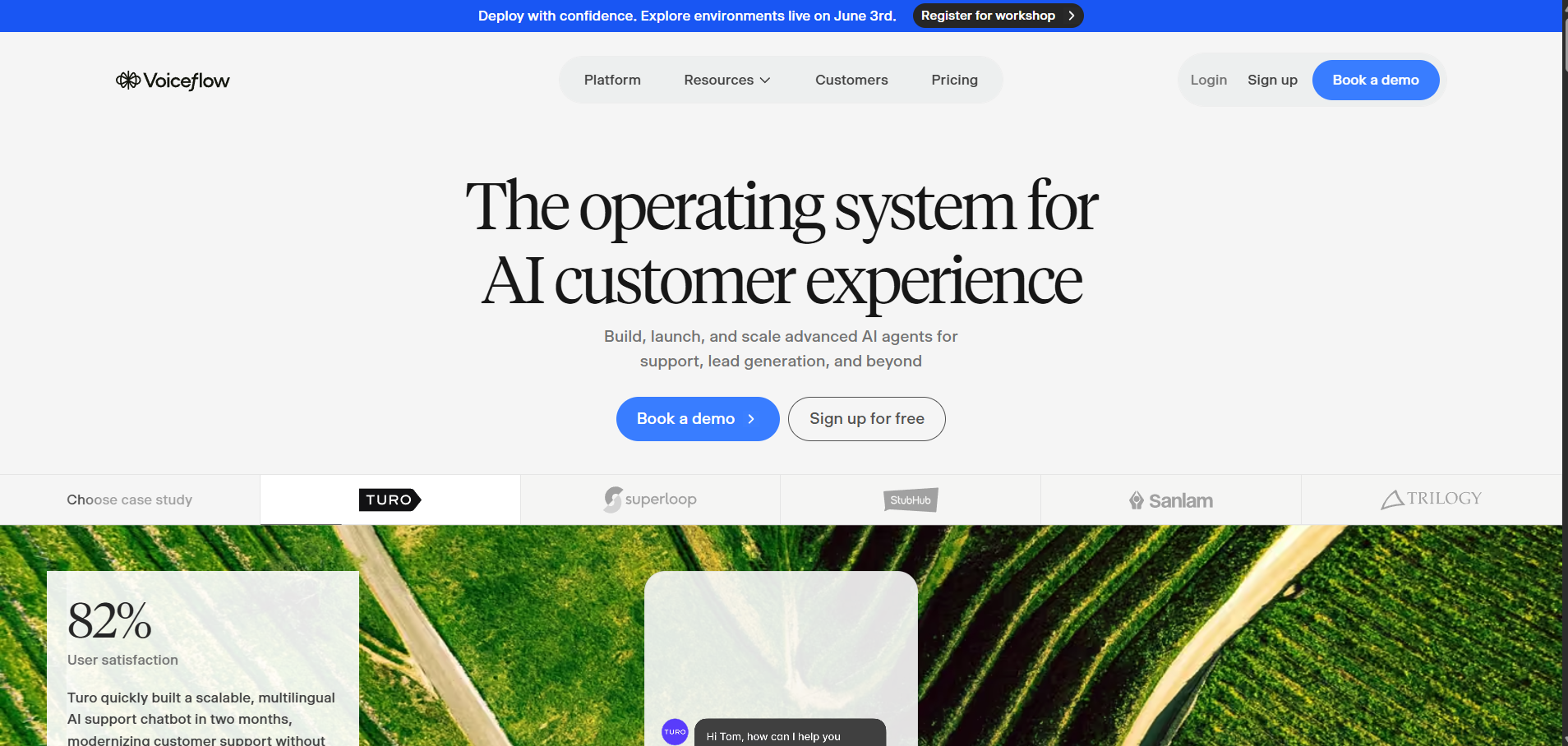
About Voiceflow
Voiceflow is a collaborative platform for designing, prototyping and shipping conversational AI — chat assistants and voice agents — without starting from code. Teams map conversations on a visual canvas, then deploy the same design as a working agent.
The canvas is the heart: drag blocks for messages, user intents, conditions, API calls and AI steps to build flows anyone on the team can read. Modern versions blend scripted control with LLM power — knowledge bases let agents answer from your documentation, while guardrails keep them on-script where accuracy matters. Deployment options span web chat widgets, WhatsApp, Alexa and custom apps via API, with analytics showing where real conversations break down.
A free tier supports learning and small projects; paid plans add team collaboration, higher volumes and enterprise controls.
Strengths: the best design-and-collaborate experience in conversational AI — designers, writers and developers work on one artifact; strong prototyping-to-production path; genuinely useful analytics. Weaknesses: complex agents still demand real conversation-design skill (the tool doesn't supply strategy); costs scale with conversation volume; and pure-LLM chatbots can be built faster elsewhere if you don't need controlled flows.
Who it's for: product and support teams building customer-facing assistants where brand voice, accuracy and cross-functional collaboration matter more than raw model freedom.
The canvas is the heart: drag blocks for messages, user intents, conditions, API calls and AI steps to build flows anyone on the team can read. Modern versions blend scripted control with LLM power — knowledge bases let agents answer from your documentation, while guardrails keep them on-script where accuracy matters. Deployment options span web chat widgets, WhatsApp, Alexa and custom apps via API, with analytics showing where real conversations break down.
A free tier supports learning and small projects; paid plans add team collaboration, higher volumes and enterprise controls.
Strengths: the best design-and-collaborate experience in conversational AI — designers, writers and developers work on one artifact; strong prototyping-to-production path; genuinely useful analytics. Weaknesses: complex agents still demand real conversation-design skill (the tool doesn't supply strategy); costs scale with conversation volume; and pure-LLM chatbots can be built faster elsewhere if you don't need controlled flows.
Who it's for: product and support teams building customer-facing assistants where brand voice, accuracy and cross-functional collaboration matter more than raw model freedom.
Frequently Asked Questions
What is Voiceflow and how does it help teams build conversational AI?
Voiceflow is a collaborative, low-code platform engineered to design, test, deploy, and monitor production-grade AI chat and voice agents. Moving away from rigid, legacy chatbot builders that required engineers to sketch out every imaginable dialog path by hand, Voiceflow provides a visual canvas that combines generative AI reasoning with strict structural control. It allows cross-functional teams of designers, product managers, and developers to collaboratively build conversational experiences that scale across web widgets, phone systems, and mobile applications.
What is the core structural difference between Voiceflow Playbooks and Workflows?
The system divides conversational logic into two distinct operational execution styles depending on whether a process needs to be flexible or strictly predictable. Playbooks handle fluid, open-ended conversations autonomously by using generative AI to figure out how to satisfy a user's intent based on custom guidelines, knowledge bases, and available tool integrations. Workflows handle multi-step processes deterministically and sequentially on a visual flowchart, making them ideal for high-risk corporate procedures like executing a payment, modifying a user password, or pushing data to a secured backend API where no conversational variance is permitted.
How does Voiceflow Core optimize model performance and token costs?
Voiceflow operates on a model-agnostic infrastructure, allowing teams to mix and match large language models from providers like OpenAI, Anthropic, and Gemini across different steps of a conversation to optimize speed and budget. To lower ongoing operation fees, the platform features a native proprietary model called Voiceflow Core, which is explicitly trained and benchmarked for tool-calling, multi-turn reasoning, and following internal playbook instructions. This is paired with an advanced Context Engine that uses a layered token filtering setup, ensuring the active model only reads the specific instructions it needs for the current step rather than processing the entire system prompt during every single turn.
What deployment channels and backend API options does the platform support?
Voiceflow functions as an interconnected omnichannel hub, enabling teams to launch a single built agent across multiple touchpoints simultaneously. It includes a native, customizable web chat widget that supports real-time voice conversations, built-in cloud telephony architectures for inbound and outbound automated phone support, and a comprehensive Conversations API for headless integration into proprietary software. For backend engineering, the platform supports pre-built ecosystem integrations for Salesforce, HubSpot, Zendesk, and Shopify alongside native functionality for direct REST API orchestration and Model Context Protocol servers to securely link internal data streams.
Do I need to code to use Voiceflow?
No — the visual canvas covers design and deployment. Developers can extend with APIs and custom code where needed.
Is Voiceflow free?
A free tier supports individual projects and learning; paid plans add collaboration, volume and enterprise features.
Can Voiceflow agents use my company documents?
Yes — knowledge bases let agents answer from your uploaded content, blending retrieval with scripted flows.
Where can I deploy a Voiceflow agent?
Website widgets, WhatsApp, voice platforms like Alexa, and custom apps through its API.
Are you the maker of Voiceflow?Add this badge to your website so visitors can see your rating.
111listing views
Live counters, all time. We show every maker the real numbers.

Want it in front of more people? Fast-track & upgrade this listing →
Alternatives
Best Voiceflow Alternatives
Looking for something like Voiceflow? These are the highest-scored Customer Support tools in our directory, ranked by score, never by who paid: Sapling, Observe.AI, Gong, Somatic AI, Canvin and more.
Sapling
Customer Support● Live
AI messaging copilot and grammar checker for enterprise customer support and sales teams.

Observe.AI
Customer Support● Live
AI platform for contact center quality assurance and agent coaching

Gong
Customer Support● Live
Revenue intelligence platform for analyzing sales conversations
Somatic AI
Customer Support● Live
Enterprise AI voice automation platform for natural, human-like automated phone calls.

Canvin
Customer Support● Live
AI conversation intelligence platform for contact center quality management

Salesloft
Customer Support● Live
Sales engagement platform for managing customer communication

Helper AI
Customer Support● Live
AI customer support untuk otomatisasi chat, knowledge base & help center.

Chorus
Customer Support● Live
AI platform for analyzing sales calls and customer conversations
📬 Get the best new AI tools by email
Only when we find tools worth your time. No spam, unsubscribe anytime.