
Healthcare
Viz.ai
AI care coordination platform for stroke and critical disease detection
Paid
★★★★½
4.8
Stroke Detection
Medical Imaging
Care Coordination
Healthcare AI
Clinical Workflow
Diagnostic AI
Radiology AI
Hospital Technology
About Viz.ai
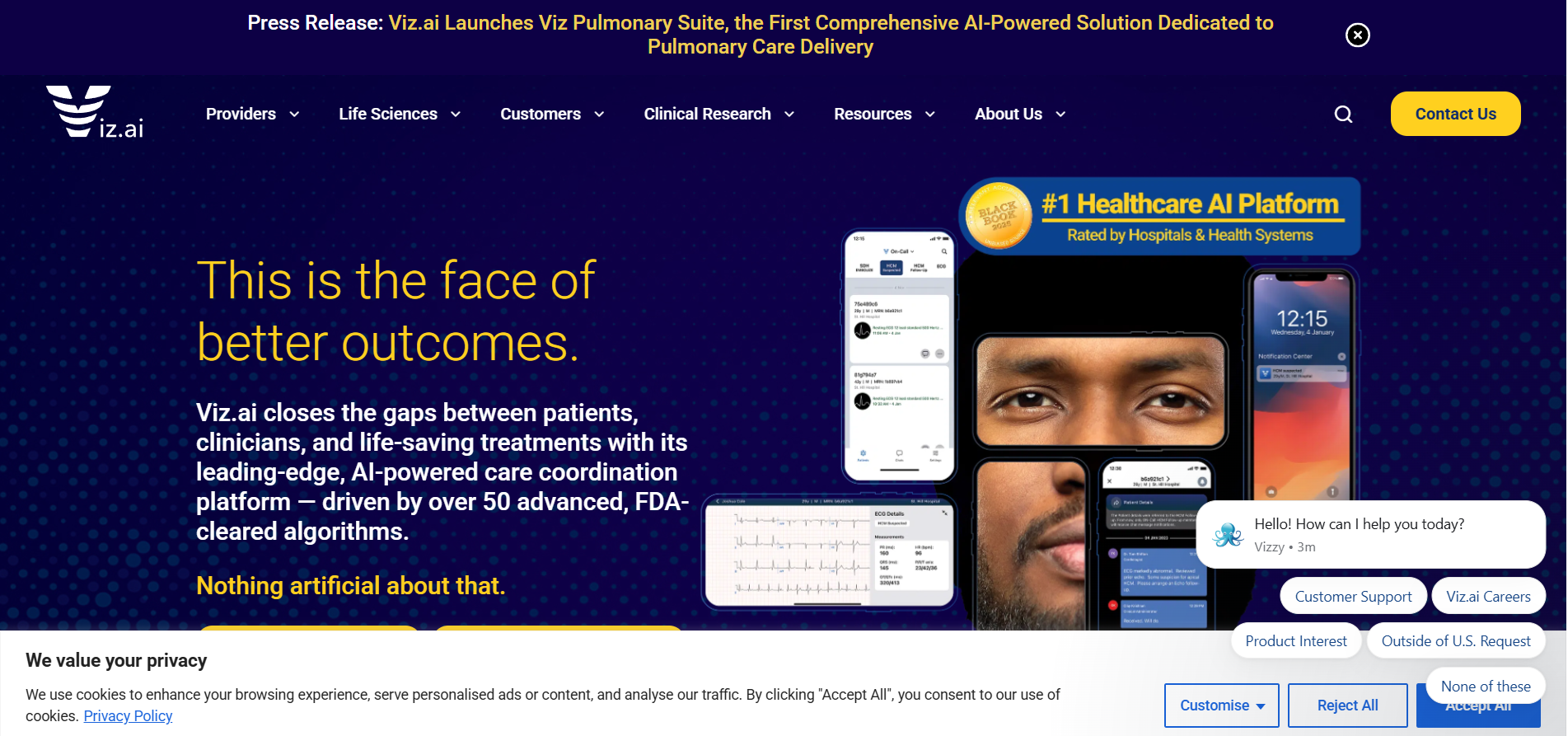
Viz.ai is an AI-powered healthcare platform that helps identify and coordinate care for patients with time-sensitive medical conditions. It analyzes medical imaging data and automatically alerts care teams when critical findings are detected. The platform is widely known for its stroke detection and treatment coordination capabilities. Viz.ai streamlines communication among healthcare professionals to reduce treatment delays and improve outcomes. It supports multiple specialties, including neurology, cardiology, and vascular care. The platform combines AI imaging analysis with clinical workflow automation.
Frequently Asked Questions
What is Viz.ai and how does it optimize hospital care coordination?
Viz.ai is an enterprise-grade medical intelligence platform engineered to eliminate systemic delays in acute care by combining automated disease detection with instant multidisciplinary communication. Operating securely within a hospital network, the platform utilizes advanced artificial intelligence to analyze patient imaging and diagnostic files—such as CT scans, EKGs, and echocardiograms—immediately upon completion. If a critical condition is suspected, Viz.ai bypasses traditional, multi-step hospital paging systems to simultaneously alert specialists and on-call teams via a secure mobile and desktop application, slashing standard triage coordination workflows from over an hour down to mere minutes.
What specialized clinical modules are available within the Viz.ai platform?
The platform is organized into highly tailored, disease-specific software suites built to manage complex acute and longitudinal care pathways. The foundational module is Viz Neuro, which automatically triages suspected large vessel occlusions and computes automated CT perfusion maps to optimize stroke interventions across hub-and-spoke hospital networks. Additionally, the platform features Viz Cardio for identifying high-risk cardiovascular conditions like hypertrophic cardiomyopathy and acute coronary syndrome, Viz Vascular for tracking abdominal aortic aneurysms, Viz Trauma for immediate emergency coordination, and the specialized Viz Pulmonary Suite to streamline the management of pulmonary embolisms and incidental lung nodules.
What is "Viz Assist" and how does the platform leverage generative AI?
Viz Assist is the platform's advanced agentic and generative AI assistant designed to ease the administrative and cognitive burdens placed on frontline clinicians. Operating alongside care teams within the central workspace, Viz Assist securely parses cross-sectional data streams to draft context-aware clinical summaries, assist with pre-charting research, and automate complex medical documentation. This intelligence layer also integrates guideline surfacing, dynamically cross-referencing real-time patient charts with official medical society directives to ensure that clinical teams are immediately prompted with appropriate risk-stratification metrics and guideline-directed treatment options at the point of care.
How does Viz.ai integrate with existing Electronic Health Records and PACS architectures?
Rather than functioning as an isolated software silo, Viz.ai is engineered with a flexible, vendor-neutral infrastructure that integrates natively into standard hospital IT environments. The platform establishes bi-directional connectivity with major Electronic Health Record systems alongside localized Picture Archiving and Communication Systems (PACS) and cross-institutional cloud architectures. This ensures that AI-driven alerts and automated 3D mobile image viewings are securely transmitted into active clinical streams, allowing specialists to review high-fidelity imaging, coordinate referrals via cross-departmental modules like Viz Connect, and confirm critical treatment decisions directly through their primary workflow interfaces.
Similar Tools
More in Healthcare

Amboss
Healthcare
Medical knowledge platform for clinical decision support and education

Abridge
Healthcare
AI platform that turns medical conversations into clinical documentation.

Hinge Health
Healthcare
Digital musculoskeletal care platform with AI-guided therapy programs.

Calm
Healthcare
Meditation and sleep app for stress reduction and wellbeing.
📬 The 5 best new AI tools, every Tuesday
One short email. No spam, unsubscribe anytime.