
Healthcare
Commure Scribe
Ambient AI scribe that automates clinical note-taking and EHR updates.
Paid
★★★★½
4.7
ambient scribe
clinical documentation
speech recognition
EHR integration
medical transcription
healthcare automation
clinician productivity
generative AI
About Commure Scribe
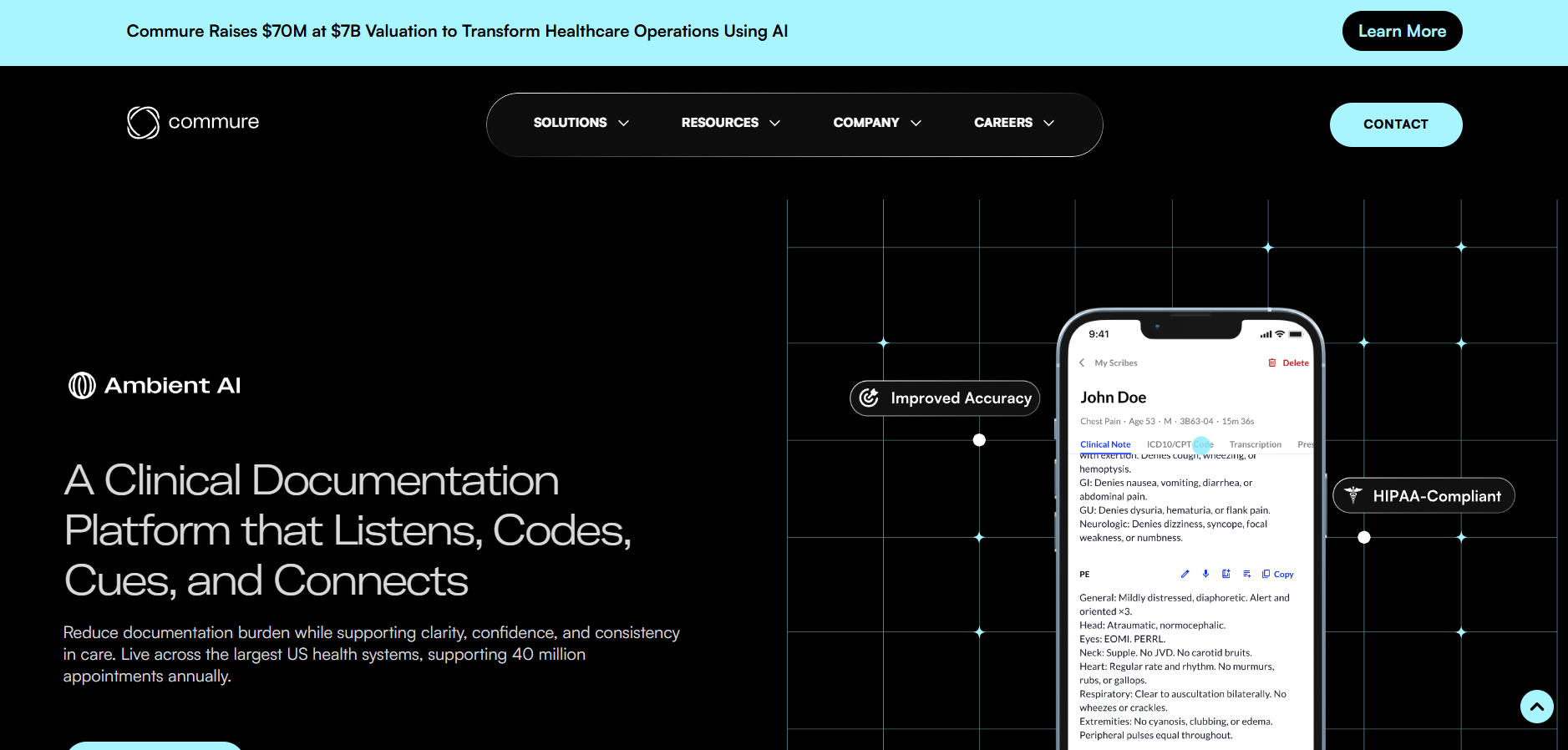
Commure Scribe, part of the Commure Ambient AI platform, uses speech recognition and generative AI to automatically capture patient encounters and generate structured clinical notes. The solution supports multiple input types, including live conversations, recordings, images, and existing notes, converting them into EHR-ready documentation. Commure Scribe integrates with major healthcare systems and is designed to reduce time spent charting while lowering cognitive burden for clinicians. The platform supports specialty-specific workflows and maintains physician control through mandatory review and approval processes. Commure has expanded rapidly across hospitals and health systems as demand for ambient AI documentation grows.
Frequently Asked Questions
What is Commure Scribe and how does it automate clinical documentation?
Commure Scribe (part of the unified Commure Ambient AI suite) is an advanced, enterprise-grade clinical co-pilot designed to eliminate administrative burdens for healthcare providers. Utilizing high-fidelity Automatic Speech Recognition (ASR) and specialty-tuned Large Language Models, the platform securely listens to natural, multi-speaker patient-clinician interactions in real time. It can track complex, continuous recordings lasting over three hours, effortlessly filtering out ambient background noise, diverse accents, and multi-lingual dialogues. Within seconds of an appointment ending, the platform transforms unstructured conversational data into fully finalized, professionally structured clinical documents such as SOAP notes, progress reports, and specialty-specific charts.
How does Commure Scribe integrate with existing Electronic Health Records (EHR)?
Commure Scribe features deep, bi-directional integration capabilities built natively for major enterprise software ecosystems, including Epic (including Epic Haiku), Cerner Millennium, athenahealth, eClinicalWorks, and MEDITECH. Operating via secure FHIR APIs, a specialized web framework, or a native Chrome extension, the system allows clinicians to complete their documentation directly inside their preferred EHR viewports without forcing manual copy-pasting. Relevant client data is securely extracted pre-visit to ground the context, and structured notes flow seamlessly into dedicated note compartments, enabling instant 1-click updates that reduce overall chart-closing latency down to less than a minute.
What makes Commure different from a standalone or point-solution medical scribe?
Unlike isolated point solutions that only capture and transcribe text, Commure Scribe is anchored within a full-stack, enterprise-wide healthcare automation infrastructure. Commure combines its ambient intelligence directly with its powerful Revenue Cycle Management (RCM) and autonomous Commure Agents ecosystem. This allows a single clinical conversation to automatically trigger downstream actions in the background without human intervention. For instance, an ambient encounter can simultaneously generate a clinical note, deploy Intelligent Care Cues for point-of-care decision support, draft patient-facing translation summaries, coordinate post-procedure care plans, and initiate automated back-office insurance prior authorizations or referral intakes.
Does Commure Scribe provide medical coding and financial optimization features?
Yes, Commure Scribe features fully embedded Autonomous Coding driven by fine-tuned, compliance-mapped machine learning models. As the clinical documentation is structured, the AI automatically evaluates the narrative text to extract and suggest highly precise CPT codes, ICD-10 diagnoses, modifiers, and relevant quality metrics. This synergy between front-end clinical notes and back-end billing reduces human coding fatigue, catches instances of administrative under-coding, and enforces strict clinical documentation integrity. Enterprise health systems utilizing this platform-wide framework report up to a 31% reduction in documentation errors alongside a 25%+ drop in insurance claim denials.
Similar Tools
More in Healthcare

Amboss
Healthcare
Medical knowledge platform for clinical decision support and education

Abridge
Healthcare
AI platform that turns medical conversations into clinical documentation.

Hinge Health
Healthcare
Digital musculoskeletal care platform with AI-guided therapy programs.

Calm
Healthcare
Meditation and sleep app for stress reduction and wellbeing.
📬 The 5 best new AI tools, every Tuesday
One short email. No spam, unsubscribe anytime.