
Healthcare
Abridge
AI platform that turns medical conversations into clinical documentation.
Ambient AI
Medical Scribe
Clinical Documentation
Healthcare AI
EHR Integration
Clinical Notes
Physician Productivity
Medical Transcription
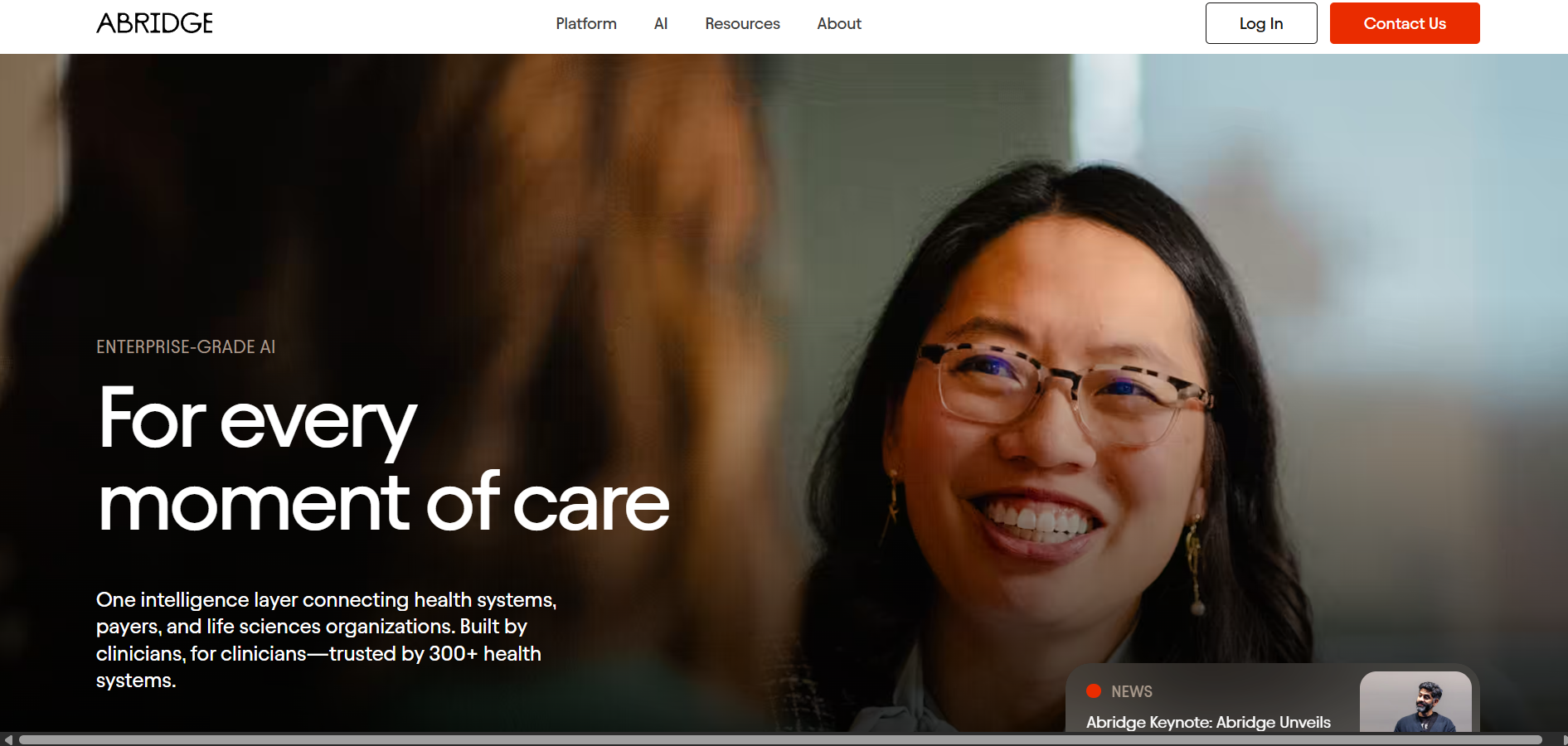
About Abridge
Abridge is a clinical documentation AI that listens to doctor-patient conversations and generates structured clinical notes in real time — attacking one of medicine's biggest burnout drivers: hours of paperwork after every shift.
During a visit, Abridge's ambient AI captures the conversation and converts it into a draft note in proper clinical structure, mapping spoken discussion to medical terminology and coding requirements, with links back to the source audio so clinicians can verify anything. It integrates directly into major EHR systems (notably Epic), so notes land where the workflow already lives, and supports multiple languages for diverse patient populations.
It's enterprise health-system software; pricing is institutional.
Strengths: significant, well-documented reduction in documentation time and after-hours charting; verifiable notes (evidence linking) rather than opaque AI output; deep EHR integration; strong adoption across major US health systems. Weaknesses: not available to individual clinicians casually — deployment is institutional; clinicians must still review and sign every note (the AI drafts, the doctor is accountable); and patient consent to recording is required.
Who it's for: hospitals, health systems and large clinics tackling clinician burnout — and a leading example of AI applied to a genuinely painful real-world problem.
During a visit, Abridge's ambient AI captures the conversation and converts it into a draft note in proper clinical structure, mapping spoken discussion to medical terminology and coding requirements, with links back to the source audio so clinicians can verify anything. It integrates directly into major EHR systems (notably Epic), so notes land where the workflow already lives, and supports multiple languages for diverse patient populations.
It's enterprise health-system software; pricing is institutional.
Strengths: significant, well-documented reduction in documentation time and after-hours charting; verifiable notes (evidence linking) rather than opaque AI output; deep EHR integration; strong adoption across major US health systems. Weaknesses: not available to individual clinicians casually — deployment is institutional; clinicians must still review and sign every note (the AI drafts, the doctor is accountable); and patient consent to recording is required.
Who it's for: hospitals, health systems and large clinics tackling clinician burnout — and a leading example of AI applied to a genuinely painful real-world problem.
Frequently Asked Questions
What is Abridge and how does it optimize healthcare documentation?
Abridge is a market-leading enterprise generative AI platform built to capture ambient conversations between clinicians and patients and instantly structure them into precise, billable medical documentation. By operating quietly in the background during medical visits, it frees healthcare professionals from staring at laptop monitors or manually typing notes during an exam. The system processes conversations in 28+ languages and across more than 55 medical specialties, dramatically cutting document-writing time and reducing clinical burnout.
What is the "Linked Evidence" feature, and how does it build clinical trust?
One of the most persistent issues with AI in high-stakes healthcare environments is the risk of "hallucinations" or missing details. Abridge directly addresses this with its unique Linked Evidence framework. Every section, symptom, or diagnosis generated in the final clinical summary is textually mapped back to the exact timestamped part of the transcript and audio recording. A doctor reviewing the draft can simply click on a summary line to instantly listen to or read the exact moment of the patient encounter that informed that detail, enabling quick, airtight verification without needing to re-listen to the entire visit.
How does Abridge integrate with primary healthcare infrastructure and EHR systems?
Rather than forcing doctors to adopt a separate web portal or manually copy-paste text, Abridge acts as a deeply embedded infrastructure layer inside major Electronic Health Record (EHR) systems—most notably featuring native write-back APIs for Epic, Oracle Health (Cerner), and athenahealth. Clinicians open the patient's chart within their standard EHR app on mobile or desktop, trigger the ambient mic, and watch the note automatically populate the correct chart fields, flowsheets, and Assessment & Plan (A&P) sections.
What advanced features were introduced to the Abridge platform in 2026?
Abridge expanded far beyond a simple "ambient scribe" to become a comprehensive clinical intelligence layer, powered heavily by models like OpenAI's GPT-5.5 alongside a key 2026 co-development partnership with NVIDIA to build highly specialized, clinical-first reasoning models. Major updates include:
Clinical Decision Support: Dynamically surfaces trusted, peer-reviewed medical evidence (partnering with NEJM and JAMA) contextualized in real time to the live discussion.
Abridge for Nurses: Ambiently captures nurse-patient bedside conversations during shifts to automatically chart verbalized findings, interventions, and patient education.
Note Personalization: Allows clinicians to save natural-language prompt instructions (e.g., "always use bullet points for headers") to dynamically tailor future outputs.
Care Signals & Clinical Trial Matching: Cross-references patient histories in real time to flag risk gaps or instantly surface eligible clinical trial opportunities during the
Clinical Decision Support: Dynamically surfaces trusted, peer-reviewed medical evidence (partnering with NEJM and JAMA) contextualized in real time to the live discussion.
Abridge for Nurses: Ambiently captures nurse-patient bedside conversations during shifts to automatically chart verbalized findings, interventions, and patient education.
Note Personalization: Allows clinicians to save natural-language prompt instructions (e.g., "always use bullet points for headers") to dynamically tailor future outputs.
Care Signals & Clinical Trial Matching: Cross-references patient histories in real time to flag risk gaps or instantly surface eligible clinical trial opportunities during the
What does Abridge do?
Listens to clinical conversations and drafts structured medical notes in real time, integrated into the EHR.
Does the doctor still review the note?
Always — Abridge drafts; the clinician verifies, edits and signs. Evidence links let them check any line against the source.
Is patient consent needed?
Yes — recording clinical conversations requires patient consent per institutional policy and local law.
Can individual doctors buy Abridge?
It's deployed through health systems and clinics rather than sold to individuals.
Are you the maker of Abridge?Add this badge to your website so visitors can see your rating.
174listing views
2visits sent to Abridge
Live counters, all time. We show every maker the real numbers.

Want it in front of more people? Fast-track & upgrade this listing →
Alternatives
Best Abridge Alternatives
Looking for something like Abridge? These are the highest-scored Healthcare tools in our directory, ranked by score, never by who paid: Commure Scribe, Regard, Aidoc, Hinge Health, Caption Health (GE HealthCare) and more.

Commure Scribe
Healthcare
Ambient AI scribe that automates clinical note-taking and EHR updates.

Regard
Healthcare
AI clinical insights platform that improves diagnosis and documentation

Aidoc
Healthcare
AI platform for medical imaging analysis and clinical workflow automation

Hinge Health
Healthcare
Digital musculoskeletal care platform with AI-guided therapy programs.

Caption Health (GE HealthCare)
Healthcare
AI-guided ultrasound software for image acquisition and analysis.

Amboss
Healthcare
Medical knowledge platform for clinical decision support and education

Nightingale Health
Healthcare
Multiomics platform delivering metabolomics insights from blood samples.

Merative
Healthcare
Healthcare analytics platform built from IBM Watson Health assets.
📬 Get the best new AI tools by email
Only when we find tools worth your time. No spam, unsubscribe anytime.