
Healthcare
Sword Health
AI-powered digital therapy platform for musculoskeletal care.
Paid
★★★★½
4.7
digital physiotherapy
musculoskeletal care
wearable sensors
rehabilitation
chronic pain
virtual care
AI healthcare
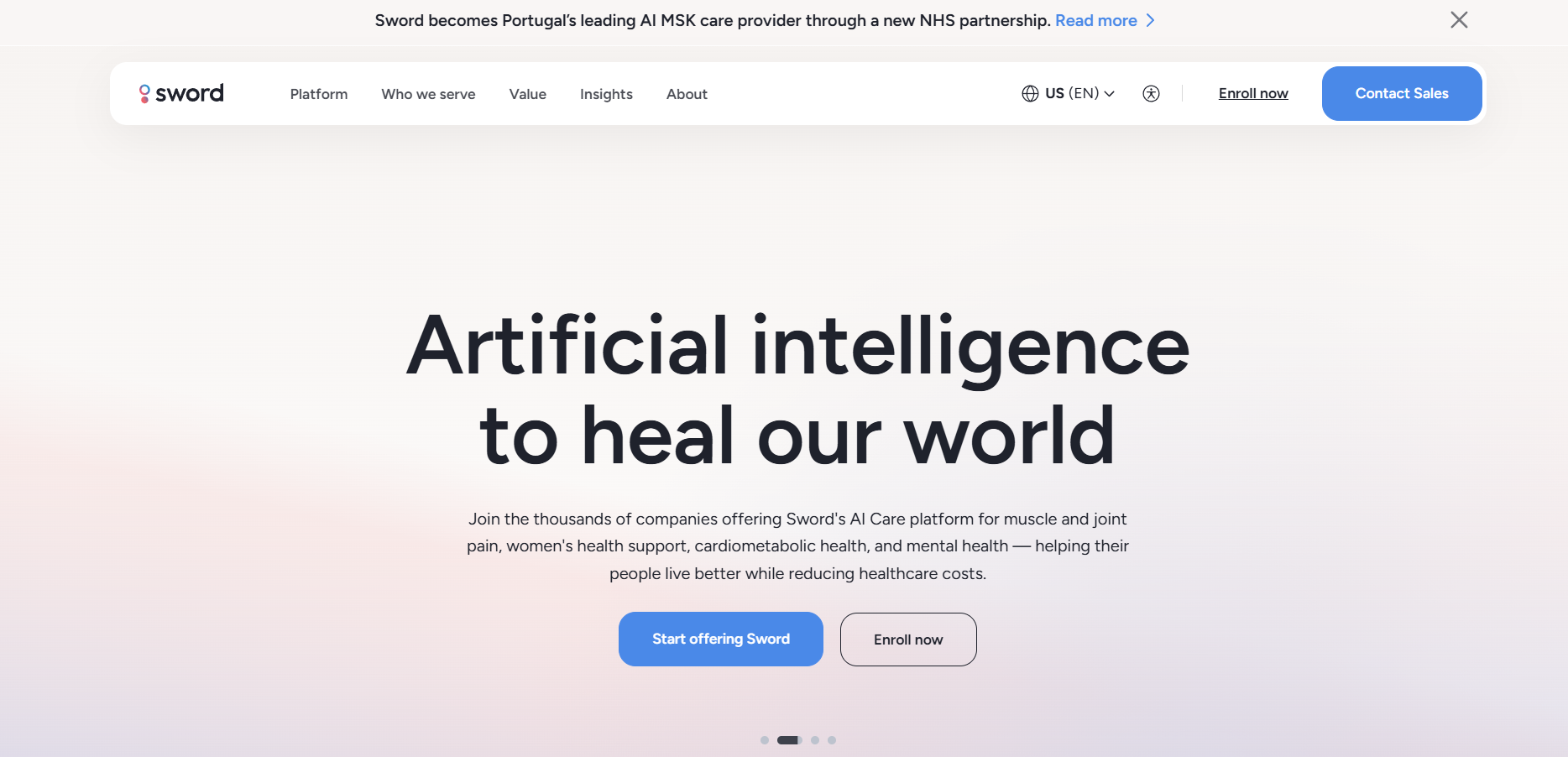
About Sword Health
Sword Health delivers virtual musculoskeletal care through AI technology, wearable motion sensors, and licensed clinicians. Its platform provides personalized exercise programs, progress tracking, and real-time feedback. Sword Health has expanded into pelvic health and mental health services through its digital care ecosystem. The company partners with employers, insurers, and health systems worldwide. Its goal is to reduce pain and unnecessary surgeries through evidence-based care.
Frequently Asked Questions
What is Sword Health and how does its AI Care Platform work?
Sword Health is a pioneer in clinical-stage virtual healthcare, combining artificial intelligence with human clinical expertise to deliver scalable care across three continents. Its core framework, the AI Care Platform, moves away from traditional, fragmented digital health point-solutions. Built with an overarching "shared clinical memory," the platform ensures a member's clinical context, symptoms, and data travel with them seamlessly across different treatment plans. Powered by Phoenix, Sword's real-time AI care specialist, the ecosystem functions as an always-on clinical assistant that interacts dynamically with patients while keeping human doctors tightly in the loop.
What is Phoenix and how does it deliver real-time voice guidance?
Phoenix is Sword's specialized conversational AI Care Specialist. Unlike generalized, off-the-shelf chatbots, Phoenix is a contextually aware, medically governed agent built on a highly sophisticated real-time orchestration architecture. It relies on a continuous, multi-modal pipeline consisting of high-fidelity Speech-to-Text (STT), specialty-tuned Large Language Models (LLMs), and responsive Text-to-Speech (TTS). Backed by speculative voice activity models and WebRTC infrastructure for minimal latency, Phoenix engages in fluid, bidirectional voice conversations with members during active exercise sessions, providing immediate motivational pacing, real-time form adjustments, and conversational support.
How does Sword Health utilize Vision AI and hardware for movement tracking?
To ensure clinical safety and precision without forcing users into specialized brick-and-mortar clinics, Sword deploys proprietary Vision AI technology. The software runs natively via the Sword Health app on everyday smartphones or tablets, eliminating the strict requirement for complex body sensors. Trained on millions of hours of biomechanical movement data, the Vision AI model tracks over 100 points on the human body simultaneously. It is capable of isolating and tracking skeletal positioning even in cluttered, noisy, or poorly lit home environments, ensuring patients maintain correct form and avoid secondary injuries.
What clinical validation and financial ROI metrics back the platform?
Sword Health is heavily anchored in data transparency, backed by peer-reviewed research and rigorous actuarial validation across more than 800,000 members. On average, commercial clients and health plans realize a 3:1 gross ROI, translating to roughly $3,177 in annual health system savings per engaged member. From a clinical standpoint, independent data shows that completing a Sword program helps 55% of high-intent members completely avoid major surgeries, while delivering a 69% reduction in limiting physical pain, a 64% drop in clinical depression scores, and an average 68% improvement in workplace productivity.
Similar Tools
More in Healthcare

Amboss
Healthcare
Medical knowledge platform for clinical decision support and education

Abridge
Healthcare
AI platform that turns medical conversations into clinical documentation.

Hinge Health
Healthcare
Digital musculoskeletal care platform with AI-guided therapy programs.

Calm
Healthcare
Meditation and sleep app for stress reduction and wellbeing.
📬 The 5 best new AI tools, every Tuesday
One short email. No spam, unsubscribe anytime.