Healthcare
Nabla Copilot
AI assistant that automates clinical notes and healthcare documentation
Ambient AI
Healthcare AI
Medical Scribe
Clinical Documentation
EHR Integration
Physician Productivity
Clinical Notes
Medical Workflows
About Nabla Copilot
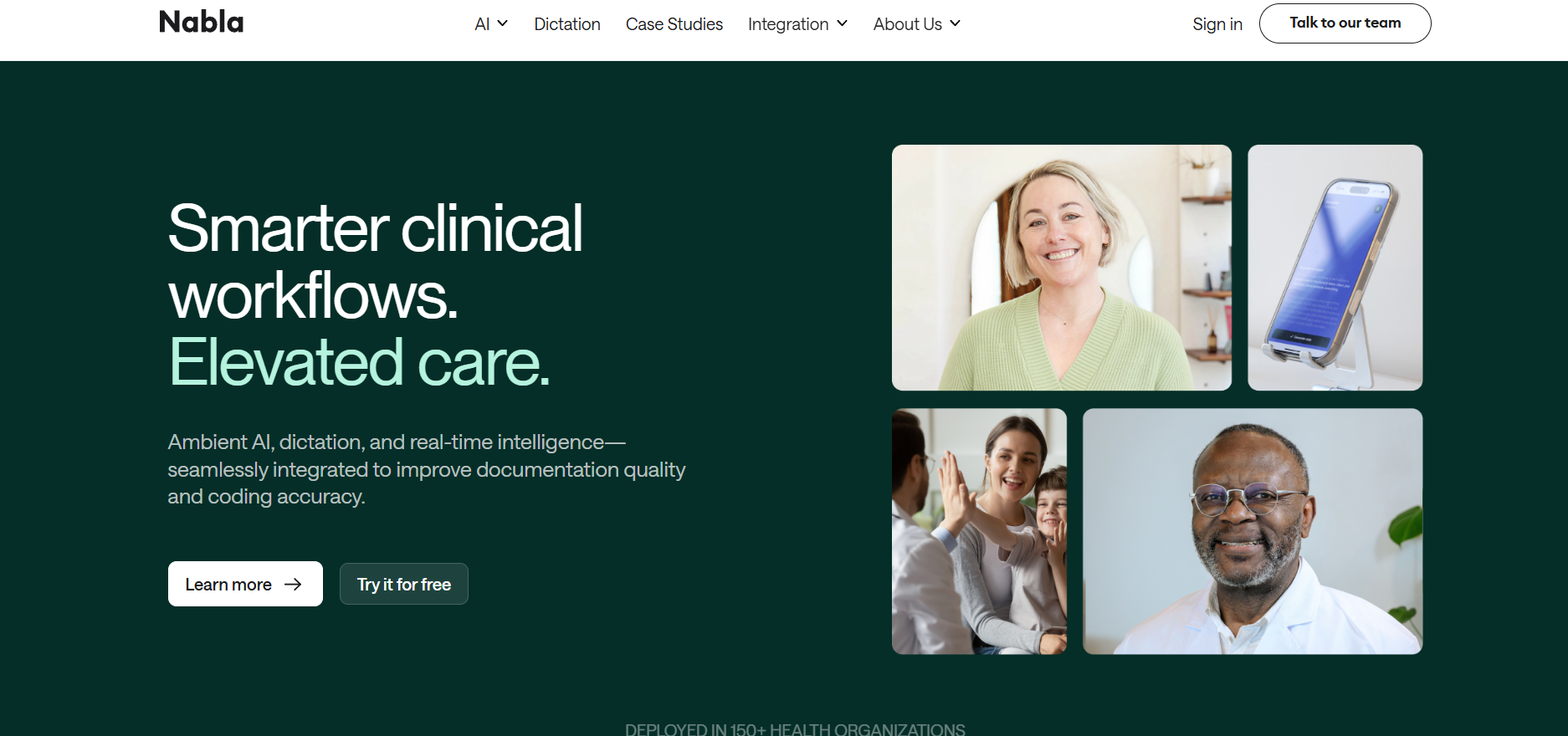
Nabla Copilot is an ambient AI assistant built specifically for healthcare professionals. It listens to clinician-patient conversations and automatically generates structured medical documentation. The platform supports multiple specialties and integrates with existing clinical workflows and EHR systems. Nabla Copilot helps reduce administrative workload while improving documentation quality and efficiency. It is known for its multilingual capabilities and user-friendly experience. Healthcare organizations use it to improve provider productivity and patient care delivery.
Frequently Asked Questions
What is Nabla Copilot and how does it optimize a clinician's daily workflow?
Nabla Copilot is an advanced ambient AI medical assistant engineered to eliminate the heavy administrative burden of manual charting for healthcare providers. By operating quietly via a device's microphone during an in-person or telehealth visit, Nabla listens to natural doctor-patient dialogue. It uses domain-specific machine learning models to automatically strip away everyday chitchat and generate highly structured, accurate clinical notes (such as SOAP notes) within seconds of finishing a consultation.
What specific customization features are available within Nabla's note generation engine?
Nabla focuses heavily on flexibility, allowing care teams to tailor outputs to match their precise documenting habits:
Specialty Fine-Tuning: Supports over 55 distinct medical specialties (such as pediatrics, cardiology, orthopedics, and mental health), adjusting clinical phrasing and formatting guidelines to match that field's standard style.
Multi-Language Comprehension: Natively understands and translates conversations happening in over 35 global languages and regional dialects.
Personalization Prompts: Clinicians can save personalized structural preferences (e.g., instructing the AI to always use bullet points for specific headings or to generate simplified, jargon-free summary notes to share directly with patients).
Specialty Fine-Tuning: Supports over 55 distinct medical specialties (such as pediatrics, cardiology, orthopedics, and mental health), adjusting clinical phrasing and formatting guidelines to match that field's standard style.
Multi-Language Comprehension: Natively understands and translates conversations happening in over 35 global languages and regional dialects.
Personalization Prompts: Clinicians can save personalized structural preferences (e.g., instructing the AI to always use bullet points for specific headings or to generate simplified, jargon-free summary notes to share directly with patients).
How does Nabla handle EHR connectivity through its platform architecture?
Rather than forcing providers to rely on repetitive copy-pasting, Nabla features a diverse, multi-tiered Electronic Health Record (EHR) integration strategy that scales from individual practices to massive health networks:
Front-End Extension (Nabla Assistant): Uses a native browser extension to inject an "Export to EHR" button directly inside a web-based EMR chart, automatically filling out text fields using localized JavaScript window events.
Back-End Integration (Nabla Core API): A deeply integrated server-side API layout designed for mobile, desktop, or proprietary telehealth software.
Nabla Connect: A plug-and-play white-label module that allows software vendors to quickly embed Nabla's complete ambient documentation engine natively into their own medical systems.
Front-End Extension (Nabla Assistant): Uses a native browser extension to inject an "Export to EHR" button directly inside a web-based EMR chart, automatically filling out text fields using localized JavaScript window events.
Back-End Integration (Nabla Core API): A deeply integrated server-side API layout designed for mobile, desktop, or proprietary telehealth software.
Nabla Connect: A plug-and-play white-label module that allows software vendors to quickly embed Nabla's complete ambient documentation engine natively into their own medical systems.
What data safety protocols protect information processed by Nabla?
Nabla maintains a strict privacy-first data framework optimized for global medical compliance under regulations like HIPAA and GDPR. The application does not store audio recordings, transcripts, or finalized clinical text on its servers after processing. Transcriptions and initial text parsing occur instantly, and the underlying AI architecture is structurally locked to prevent patient interaction data from ever being used to train external, public large language models.
Are you the maker of Nabla Copilot?Add this badge to your website so visitors can see your rating.
115listing views
1visits sent to Nabla Copilot
Live counters, all time. We show every maker the real numbers.

Want it in front of more people? Fast-track & upgrade this listing →
Alternatives
Best Nabla Copilot Alternatives
Looking for something like Nabla Copilot? These are the highest-scored Healthcare tools in our directory, ranked by score, never by who paid: Commure Scribe, Regard, Abridge, Aidoc, Hinge Health and more.

Commure Scribe
Healthcare
Ambient AI scribe that automates clinical note-taking and EHR updates.

Regard
Healthcare
AI clinical insights platform that improves diagnosis and documentation

Abridge
Healthcare
AI platform that turns medical conversations into clinical documentation.

Aidoc
Healthcare
AI platform for medical imaging analysis and clinical workflow automation

Hinge Health
Healthcare
Digital musculoskeletal care platform with AI-guided therapy programs.

Caption Health (GE HealthCare)
Healthcare
AI-guided ultrasound software for image acquisition and analysis.

Amboss
Healthcare
Medical knowledge platform for clinical decision support and education

Nightingale Health
Healthcare
Multiomics platform delivering metabolomics insights from blood samples.
📬 Get the best new AI tools by email
Only when we find tools worth your time. No spam, unsubscribe anytime.