
Healthcare
Freed AI
AI medical scribe that automates clinical notes from patient visits
Medical Scribe
Healthcare AI
Clinical Documentation
Ambient AI
Physician Productivity
Clinical Notes
Medical Transcription
EHR Workflows
About Freed AI
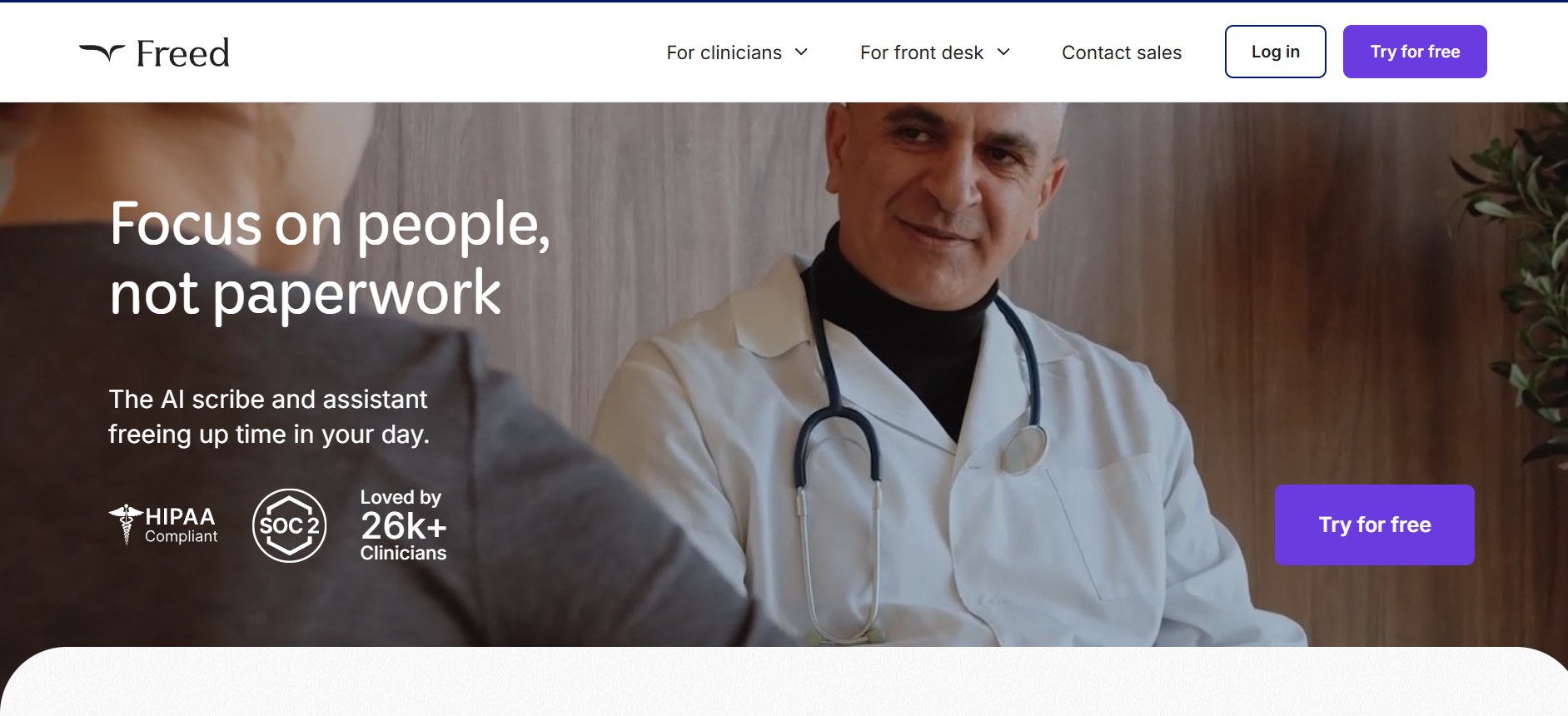
Freed AI is an AI-powered medical scribe designed to reduce the documentation burden for healthcare professionals. The platform listens to patient visits and automatically generates structured clinical notes in real time. It supports various specialties and integrates easily into existing clinical workflows. Freed AI helps clinicians spend less time on paperwork and more time with patients. The platform emphasizes ease of use, fast note generation, and HIPAA-compliant workflows. It is widely adopted by independent practitioners and healthcare organizations seeking efficient documentation solutions.
Frequently Asked Questions
What is Freed AI and who is it primarily designed for?
Freed AI is an intelligent ambient medical scribe and documentation assistant created specifically to alleviate administrative burnout for medical professionals. Unlike sprawling corporate AI tools built for massive hospital systems, Freed is purposefully engineered for solo clinicians, community care practitioners, physical therapists, and mental health professionals. It operates quietly on a mobile device, tablet, or desktop during a patient visit, listening to natural conversation and instantly distilling it into structured, healthcare-grade clinical text.
How does Freed capture clinical context during an encounter?
The software utilizes real-time ambient encounter capture, meaning clinicians do not need to speak into a microphone using robotic dictation commands or alter the natural organic flow of a patient consultation. Freed’s machine learning engine naturally separates casual patient chitchat from clinically significant data. Within seconds of tapping "End Visit," it structures the medical facts into standard layouts like SOAP notes, progress reports, or History & Physical (H&P) profiles.
What specific tools are included in Freed's post-visit automation suite?
Beyond standard text summaries, Freed acts as a full-service documentation assistant to handle downstream clinical tasks right after an appointment:
AI Clinician Assistant: A natural-language editing copilot that allows users to issue prompt commands (e.g., "make the summary more concise" or "restructure the subjective section") to modify the text.
Visit Prep & Pre-Charting: Intelligently analyzes previous visit notes to surface quick patient history summaries and necessary follow-up tasks before the next appointment begins.
Coding & Documentation Generation: Instantly predicts accurate, billable ICD-10, CPT, and E/M codes based on the context of the live visit, while simultaneously drafting referral letters, school/work sick notes, and plain-language patient instruction sheets.
AI Clinician Assistant: A natural-language editing copilot that allows users to issue prompt commands (e.g., "make the summary more concise" or "restructure the subjective section") to modify the text.
Visit Prep & Pre-Charting: Intelligently analyzes previous visit notes to surface quick patient history summaries and necessary follow-up tasks before the next appointment begins.
Coding & Documentation Generation: Instantly predicts accurate, billable ICD-10, CPT, and E/M codes based on the context of the live visit, while simultaneously drafting referral letters, school/work sick notes, and plain-language patient instruction sheets.
How does the platform handle EHR connectivity and "Learn My Format" training?
Freed is designed to adapt to the clinician's workflow rather than forcing them to adopt rigid software templates. Its Learn My Format feature allows a provider to copy and paste their personal historical notes, training the AI to mimic their exact stylistic shortcuts, preferred vocabulary, and shorthand structural habits over time. When notes are complete, a single click transmits the finalized documentation straight into standard Electronic Health Record (EHR) systems—such as Athena, eClinicalWorks, and SimplePractice.
Are you the maker of Freed AI?Add this badge to your website so visitors can see your rating.
81listing views
1visits sent to Freed AI
Live counters, all time. We show every maker the real numbers.

Want it in front of more people? Fast-track & upgrade this listing →
Alternatives
Best Freed AI Alternatives
Looking for something like Freed AI? These are the highest-scored Healthcare tools in our directory, ranked by score, never by who paid: Commure Scribe, Regard, Abridge, Aidoc, Hinge Health and more.

Commure Scribe
Healthcare
Ambient AI scribe that automates clinical note-taking and EHR updates.

Regard
Healthcare
AI clinical insights platform that improves diagnosis and documentation

Abridge
Healthcare
AI platform that turns medical conversations into clinical documentation.

Aidoc
Healthcare
AI platform for medical imaging analysis and clinical workflow automation

Hinge Health
Healthcare
Digital musculoskeletal care platform with AI-guided therapy programs.

Caption Health (GE HealthCare)
Healthcare
AI-guided ultrasound software for image acquisition and analysis.

Amboss
Healthcare
Medical knowledge platform for clinical decision support and education

Nightingale Health
Healthcare
Multiomics platform delivering metabolomics insights from blood samples.
📬 Get the best new AI tools by email
Only when we find tools worth your time. No spam, unsubscribe anytime.