
Voice & Speech
Coqui TTS
Open-source AI speech synthesis toolkit for voice generation.
Website checked and live 2 days ago · how we check
Text-to-Speech
Open Source
Voice Cloning
Speech Synthesis
AI Development
Machine Learning
Developer Tools
Multilingual Voices
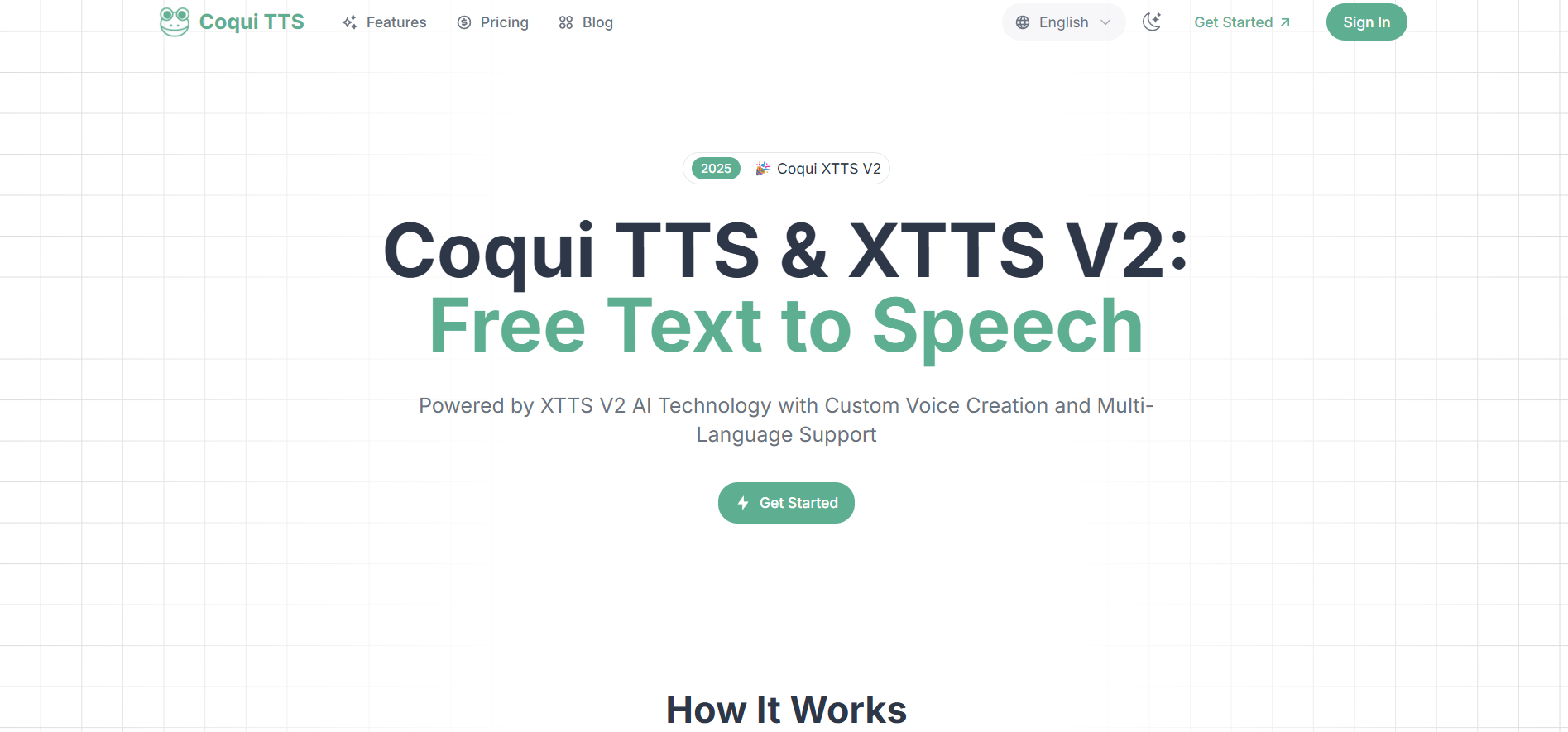
About Coqui TTS
Coqui TTS is one of the most complete open-source text-to-speech toolkits — a library that lets developers run, train and fine-tune speech synthesis models on their own hardware, with support for dozens of languages and voice cloning from short samples.
Born from Mozilla's TTS research, Coqui packages state-of-the-art architectures behind a usable Python API: generate speech in 1,100+ languages via massively multilingual models, clone a voice from seconds of reference audio (XTTS), stream with low latency, and train custom voices on your own datasets. Because it runs locally, audio never leaves your infrastructure — the privacy and cost profile commercial APIs can't offer at scale.
The software is free and open source. (The company behind it shut down; the models and an active community fork live on — expect community support rather than a vendor.)
Strengths: no per-character API costs, full data privacy, real multilingual breadth, and trainability for custom voices. Weaknesses: developer-oriented setup (Python, GPU for best results), best-model licensing restricts some commercial uses — check the specific model's license — and polish trails paid leaders like ElevenLabs.
Who it's for: developers building voice features at volume, privacy-sensitive projects, researchers, and products needing offline or on-premise speech.
Born from Mozilla's TTS research, Coqui packages state-of-the-art architectures behind a usable Python API: generate speech in 1,100+ languages via massively multilingual models, clone a voice from seconds of reference audio (XTTS), stream with low latency, and train custom voices on your own datasets. Because it runs locally, audio never leaves your infrastructure — the privacy and cost profile commercial APIs can't offer at scale.
The software is free and open source. (The company behind it shut down; the models and an active community fork live on — expect community support rather than a vendor.)
Strengths: no per-character API costs, full data privacy, real multilingual breadth, and trainability for custom voices. Weaknesses: developer-oriented setup (Python, GPU for best results), best-model licensing restricts some commercial uses — check the specific model's license — and polish trails paid leaders like ElevenLabs.
Who it's for: developers building voice features at volume, privacy-sensitive projects, researchers, and products needing offline or on-premise speech.
Frequently Asked Questions
Is Coqui.ai still active in 2026?
The original company, Coqui AI, officially shut down in early 2024. However, the project was "reborn" through its massive open-source community. In 2026, the software is primarily maintained via the idiap/coqui-ai-TTS fork on GitHub and the coqui-tts package on PyPI, which receives regular monthly updates and bug fixes from independent developers.
What is the difference between coqui.ai and coquitts.com?
While coqui.ai was the original home of the project, coquitts.com has emerged as a community-facing landing page for documentation and review. For the most up-to-date code and technical implementation, developers should refer directly to the GitHub repositories or the ReadTheDocs documentation, as the original SaaS dashboard is no longer functional.
What are the key technical strengths of the 2026 version?
Coqui remains a leader in few-shot voice cloning. Its flagship model, XTTS-v2, can clone a human voice with 85–95% accuracy using just a 6-second audio sample. It supports over 17 primary languages for deep cloning and provides pre-trained models for over 1,100 languages, making it one of the most linguistically diverse open-source tools available.
Can I run Coqui TTS locally for privacy?
Yes. One of its greatest advantages in 2026 is its "Zero-Footprint" privacy. Because the engine can be deployed locally using Docker or Python, your voice data never leaves your machine. To achieve professional performance (sub-200ms latency), it is recommended to use a machine with at least 8GB of NVIDIA VRAM.
Is Coqui TTS free?
The toolkit is open source and free to run. Note that some flagship models carry licenses restricting commercial use — check per model.
Can Coqui clone voices?
Yes — XTTS can clone a voice from a short audio sample and speak in multiple languages with it. Use only voices you have rights to.
Does Coqui work offline?
Yes — everything runs locally, making it suitable for private or air-gapped deployments.
Coqui vs ElevenLabs?
ElevenLabs is more polished with zero setup; Coqui trades convenience for free volume, privacy and full control.
Are you the maker of Coqui TTS?Add this badge to your website so visitors can see your rating.
105listing views
Live counters, all time. We show every maker the real numbers.

Want it in front of more people? Fast-track & upgrade this listing →
Alternatives
Best Coqui TTS Alternatives
Looking for something like Coqui TTS? These are the highest-scored Voice & Speech tools in our directory, ranked by score, never by who paid: Auphonic, Maestra, Hedy AI, TTSMaker, Picovoice and more.
Auphonic
Voice & Speech● Live
AI audio post-production tool for leveling, noise reduction, and encoding.

Maestra
Voice & Speech● Live
AI platform for transcription, subtitles, translation, and voiceovers

Hedy AI
Voice & Speech● Live
AI meeting coach with real-time transcription, summaries, and live guidance.

TTSMaker
Voice & Speech● Live
Free AI text-to-speech tool with multilingual voice generation

Picovoice
Voice & Speech● Live
oice AI platform for on-device speech recognition and wake words

Microsoft Azure Speech
Voice & Speech● Live
Enterprise speech-to-text and text-to-speech API by Microsoft Azure.

Kits.ai
Voice & Speech● Live
AI platform for voice cloning, voice generation, and vocal creation

ElevenLabs
Voice & Speech● Live
Ultra-realistic text-to-speech and voice cloning.
📬 Get the best new AI tools by email
Only when we find tools worth your time. No spam, unsubscribe anytime.