
Coding & Dev
Wit.ai
Free platform for building voice and text conversational applications
Website checked and live 5 days ago · how we check
NLP
Conversational AI
Speech Recognition
Chatbots
Voice Assistants
Intent Detection
Entity Extraction
Developer Tools
About Wit.ai
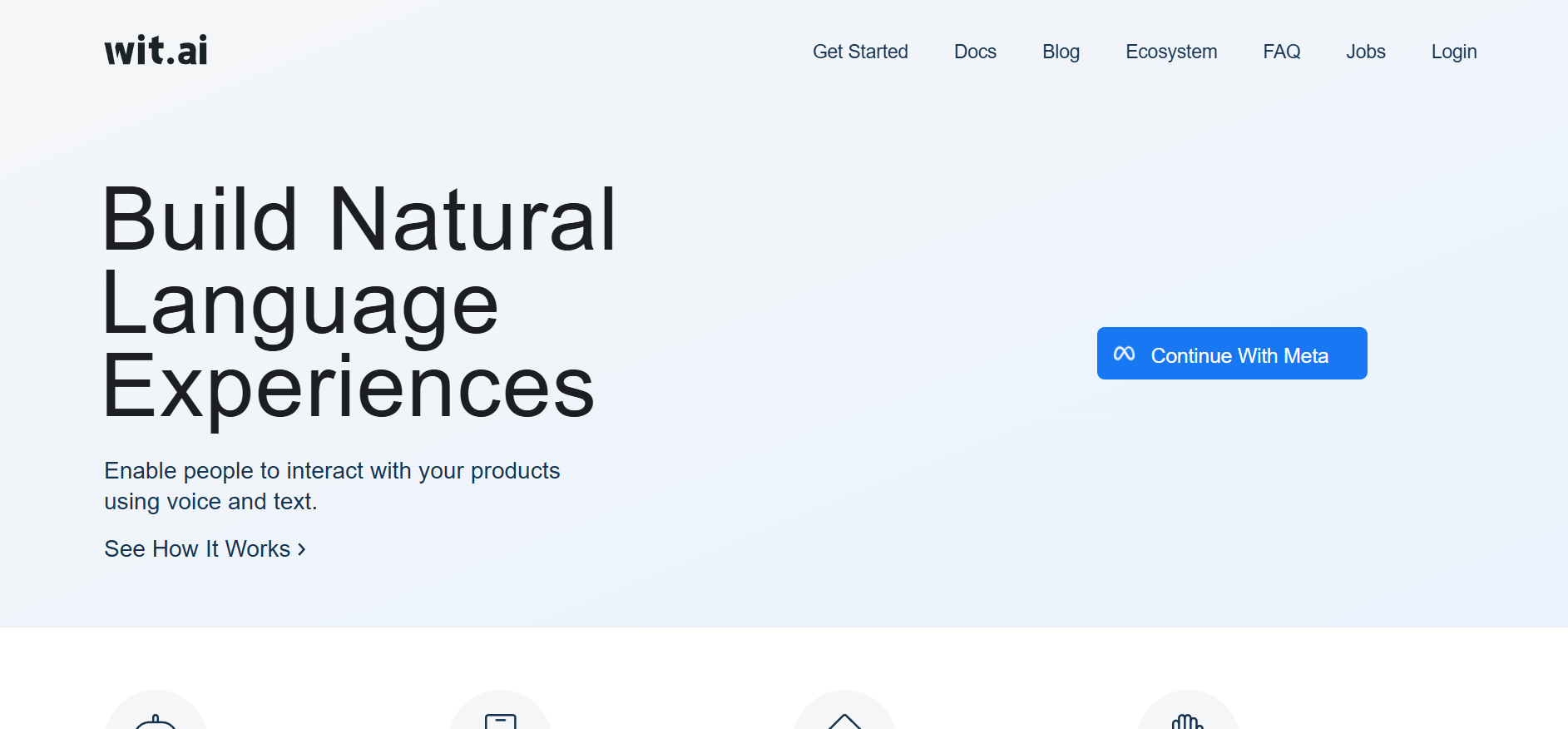
Wit.ai is Meta's free natural-language platform for turning text or speech into structured intent — the toolkit for teaching your app to understand "book me a table for four at eight" as a reservation request with specific parameters.
You train it by example: provide sample phrases, label the intents and entities inside them, and Wit learns to parse new variations. It handles many languages, supports speech input alongside text, and exposes everything through a simple API with SDKs. Its most remarkable feature remains the price: free, with no usage tier gymnastics — unusual in a category where NLU platforms charge per request.
Strengths: free for production use, genuinely easy to start (a working intent model in an afternoon), decent multilingual support, and Meta's infrastructure behind it. Weaknesses: development pace has been quiet compared to LLM-based alternatives; modern language models often handle intent extraction more flexibly without training data; support is community-driven; and your training data lives with Meta — a consideration for sensitive domains.
Who it's for: developers and students building chatbots, voice commands or command parsers on a zero budget — and anyone wanting to learn NLU fundamentals with a forgiving, free platform.
You train it by example: provide sample phrases, label the intents and entities inside them, and Wit learns to parse new variations. It handles many languages, supports speech input alongside text, and exposes everything through a simple API with SDKs. Its most remarkable feature remains the price: free, with no usage tier gymnastics — unusual in a category where NLU platforms charge per request.
Strengths: free for production use, genuinely easy to start (a working intent model in an afternoon), decent multilingual support, and Meta's infrastructure behind it. Weaknesses: development pace has been quiet compared to LLM-based alternatives; modern language models often handle intent extraction more flexibly without training data; support is community-driven; and your training data lives with Meta — a consideration for sensitive domains.
Who it's for: developers and students building chatbots, voice commands or command parsers on a zero budget — and anyone wanting to learn NLU fundamentals with a forgiving, free platform.
Frequently Asked Questions
What is Wit.ai and how does it assist developers in building conversational apps?
Wit.ai is an open, cloud-based natural language processing (NLP) platform engineered by Meta that allows developers to add intelligent voice and text interfaces to their applications. The software interprets unstructured human speech or text commands and converts them into structured, machine-readable data. It is widely used to power conversational chatbots, complex mobile application commands, wearable smart devices, and automated smart-home ecosystems.
What core NLU mechanics are used to parse user commands within the platform?
The machine learning framework breaks down text and audio inputs into three core components to decode a user's true message:
Intents: The primary objective or goal behind a user's phrase (e.g., recognizing that "turn up the heat" means the user wants to change the climate control).
Entities: The specific, detailed variables inside the sentence that provide critical context (e.g., extracting "living room" as the location and "72 degrees" as the exact value).
Traits: Built-in semantic identifiers that evaluate the overall tone, sentiment, or communication style of the message without being tied to a specific keyword or entity.
Intents: The primary objective or goal behind a user's phrase (e.g., recognizing that "turn up the heat" means the user wants to change the climate control).
Entities: The specific, detailed variables inside the sentence that provide critical context (e.g., extracting "living room" as the location and "72 degrees" as the exact value).
Traits: Built-in semantic identifiers that evaluate the overall tone, sentiment, or communication style of the message without being tied to a specific keyword or entity.
How does Wit.ai support multi-language applications and community scaling?
The platform features an expansive multilingual architecture that natively supports over 132 languages and local dialects. Because it is community-driven, developers can opt to share training datasets and linguistic models publicly within the ecosystem. This allows apps built on Wit.ai to learn and adapt to regional slangs, unique vocabulary shifts, and global accents much faster by crowdsourcing structural data patterns across thousands of independent projects.
What are Wit.ai's voice parsing tools and deployment capabilities?
Beyond processing simple text commands, Wit.ai contains a high-accuracy, built-in speech recognition engine that transcribes real-time audio clips on the fly. It also includes an advanced visual development feature called Composer, which helps teams visually draft, test, and map out complex, multi-turn conversational paths and API hooks. The entire architecture runs over a lightweight, platform-agnostic cloud API, making it simple for developers to deploy their finished models to web setups, mobile apps, hardware microcontrollers, or Meta's own Messenger ecosystem.
Is Wit.ai really free?
Yes — Wit.ai is free to use, including in production, which is its standout advantage.
What does Wit.ai do?
Converts natural language (typed or spoken) into structured intents and entities your app can act on.
Wit.ai vs using an LLM for intents?
LLMs handle open-ended phrasing more flexibly without training examples; Wit.ai offers a lightweight, free, predictable classifier — good for constrained command sets.
Does Wit.ai support voice?
Yes — it accepts speech input as well as text.
Are you the maker of Wit.ai?Add this badge to your website so visitors can see your rating.
75listing views
Live counters, all time. We show every maker the real numbers.

Want it in front of more people? Fast-track & upgrade this listing →
Alternatives
Best Wit.ai Alternatives
Looking for something like Wit.ai? These are the highest-scored Coding & Dev tools in our directory, ranked by score, never by who paid: DaoXE, FastLLM, AtlasBurn, GitHub Copilot, Cursor and more.

DaoXE
Coding & Dev● Live
OpenAI-compatible API gateway for multiple AI models through one endpoint.
AI
PaidFastLLM
Coding & Dev● Live
Prepaid AI gateway for GPT, Claude and image models.

AtlasBurn
Coding & Dev · LLM Cost Monitoring● Live
Monitor and control your OpenAI, Anthropic and Gemini API costs with budget guardrails that stop runaway spend.

GitHub Copilot
Coding & Dev● Live
AI pair programmer inside your editor.

Cursor
Coding & Dev● Live
AI-first code editor with deep codebase understanding, advanced refactoring, and autonomous coding

BytePlus AI
Coding & Dev● Live
Enterprise AI platform providing APIs and foundation models.

Durable
Coding & Dev● Live
Build a full AI-generated business website in under 30 seconds.

AutoGPT
Coding & Dev● Live
Open-source AI agent that automates complex workflows autonomously.
📬 Get the best new AI tools by email
Only when we find tools worth your time. No spam, unsubscribe anytime.