
Healthcare
Butterfly Network
Handheld AI ultrasound platform for point-of-care imaging.
Paid
★★★★½
4.7
handheld ultrasound
point-of-care ultrasound
medical imaging
AI diagnostics
ultrasound-on-chip
radiology AI
telemedicine
About Butterfly Network
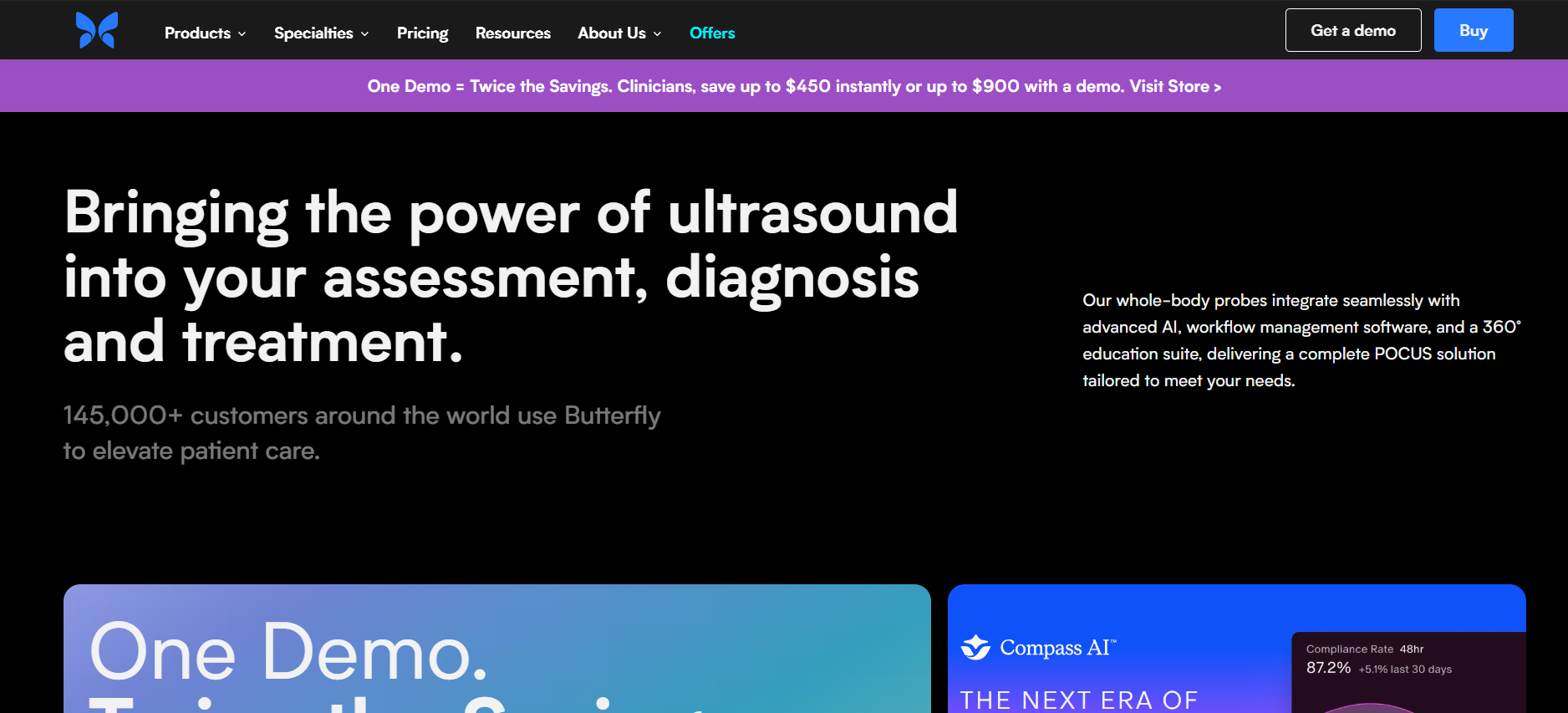
Butterfly Network develops portable ultrasound devices powered by its proprietary Ultrasound-on-Chip™ technology. Its flagship Butterfly iQ series enables whole-body imaging through a single handheld probe connected to a smartphone or tablet. The company combines AI-powered guidance, image analysis, cloud software, and educational tools to expand access to point-of-care ultrasound. Recent innovations include FDA-cleared AI features for automated pregnancy assessment and enterprise workflow management. Butterfly's platform is widely used across emergency medicine, primary care, and global health initiatives.
Frequently Asked Questions
What is Butterfly Network and how does its ultrasound technology work?
Our mission is to democratize healthcare by making medical imaging accessible to everyone around the world. Traditional ultrasound systems rely on bulky, fragile, and expensive piezoelectric crystals, requiring multiple separate probes to switch between shallow and deep scanning depths. Butterfly completely replaces this architecture with its proprietary Ultrasound-on-Chip™ technology, which integrates thousands of micro-machined sensors onto a single silicon semiconductor chip. This allows a single pocket-sized probe to perform whole-body imaging across thousands of distinct clinical applications, translating physical hardware into software that continuously improves over time.
What are the primary differences between the Butterfly iQ+ and the next-generation Butterfly iQ3?
Both systems connect natively to a compatible mobile device to deliver rapid Point-of-Care Ultrasound, but they represent distinct evolutionary steps in semiconductor imaging. The foundational Butterfly iQ+ costs $2,699 and utilizes second-generation chip architecture with 1.75D array beamforming to offer fast frame rates and military-grade durability for everyday clinical shifts. In contrast, the next-generation Butterfly iQ3 costs $3,899 and is built on advanced P4.3 silicon technology, featuring a 17% smaller probe face for significantly better access between the ribs and during vascular procedures. Furthermore, the iQ3 doubles data processing speeds to dramatically enhance image resolution, sensitivity, and depth penetration while introducing specialized 3D virtual tilting modes like iQ Slice and iQ Fan that capture multiple angles without physical movement.
What advanced AI and software tools are integrated into the Butterfly platform?
The ecosystem pairs portable hardware with robust artificial intelligence to guide scanning, automate measurements, and streamline complex bedside workflows. On the advanced iQ3 device, software features like iQ Slice and iQ Fan leverage fast electronic steering to automatically capture multiple image angles from a fixed position on the skin. Across the platform, intelligent modules like Auto Bladder and the Auto B-Line Counter instantly calculate 3D bladder volumes or detect and count lung B-lines from a brief six-second clip to accelerate emergency evaluations for breathing difficulties. These clinical tools are supported by Compass Software, an enterprise-grade management platform that automates documentation, tracks quality assurance reviews, and organizes medical billing structures across health systems.
Who uses Butterfly devices and how are they integrated into clinical systems?
Butterfly is widely utilized across a vast range of clinical specialties including emergency medicine, critical care, anesthesia, cardiology, obstetrics, nursing, and military medicine. The platform operates on a vendor-neutral cloud framework that connects securely with hospital Picture Archiving and Communication Systems and Electronic Health Records via standard middleware or specialized development toolkits like Butterfly Garden. All medical data pipelines are fully encrypted, ensuring full compliance with HIPAA and global privacy data standards, while maintaining information security milestones like GovRAMP and TX-RAMP certifications.
Similar Tools
More in Healthcare

Amboss
Healthcare
Medical knowledge platform for clinical decision support and education

Abridge
Healthcare
AI platform that turns medical conversations into clinical documentation.

Hinge Health
Healthcare
Digital musculoskeletal care platform with AI-guided therapy programs.

Calm
Healthcare
Meditation and sleep app for stress reduction and wellbeing.
📬 The 5 best new AI tools, every Tuesday
One short email. No spam, unsubscribe anytime.