
Voice & Speech
Bark
Open-source generative AI model for speech, music, and audio
Website checked and live 2 days ago · how we check
Generative Audio
Text-to-Speech
Open Source
Audio AI
Voice Synthesis
Research Tool
Speech Generation
Sound Effects
About Bark
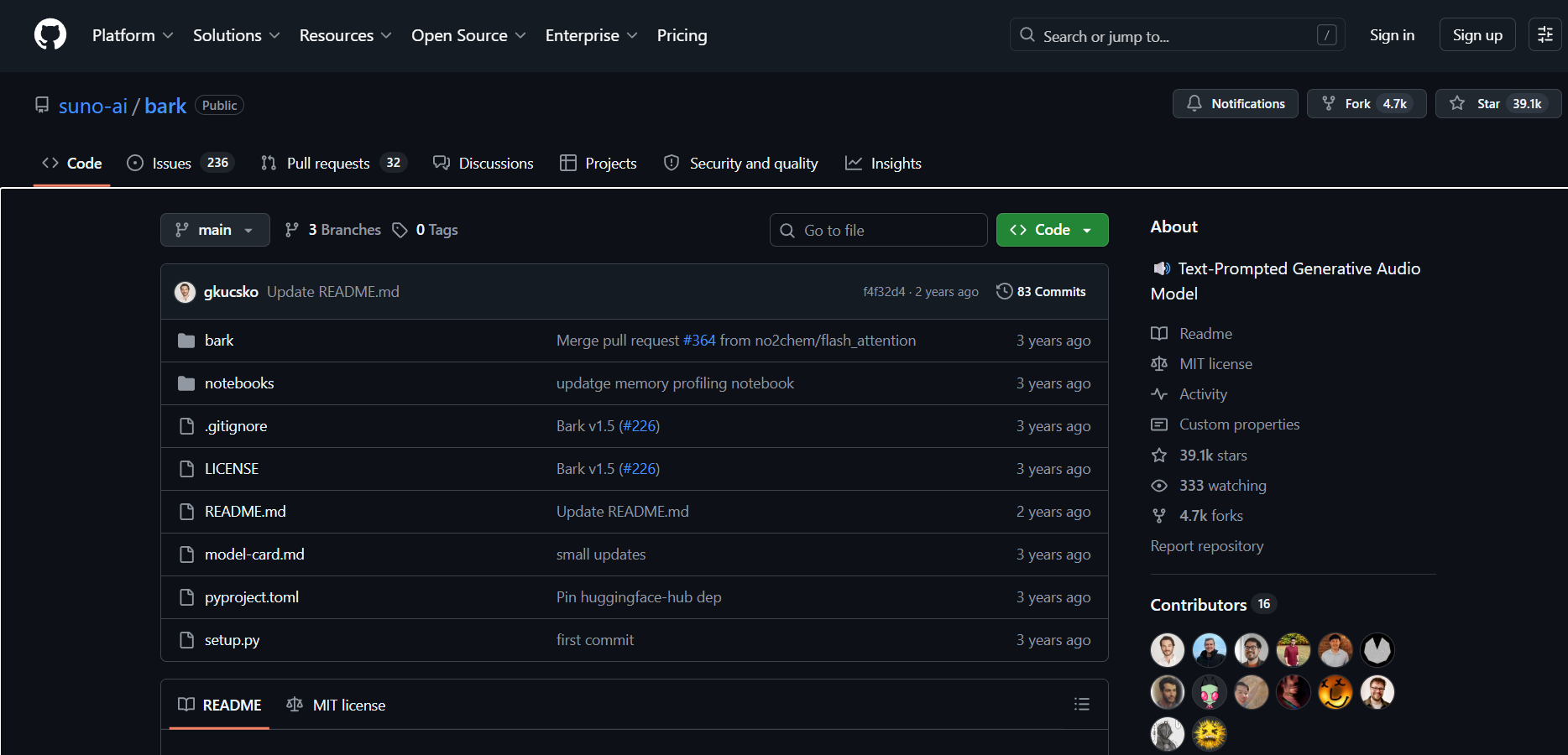
Bark, by Suno, is an open-source generative audio model that goes beyond standard text-to-speech: it generates not just spoken words but laughter, sighs, hesitations, music snippets and sound effects — audio that behaves less like a robot reading and more like a performance.
Unlike conventional TTS that converts text phoneme-by-phoneme, Bark is a fully generative model: give it text (including cues like [laughs] or ♪ for singing) and it produces expressive audio in multiple languages, with a variety of preset voices. Being open source, it's free to run locally or in notebooks, modify, and build into applications — a research-grade capability in public hands.
Strengths: expressiveness no classic TTS matches (nonverbal sounds, emotional coloring), true multilingual generation, zero cost, and full local control for developers. Weaknesses: output is less controllable and less consistently polished than commercial services like ElevenLabs — generations vary, longer texts need chunking, and it requires technical comfort (Python, a decent GPU) rather than offering a friendly web app. Voice cloning is deliberately restricted for safety.
Who it's for: developers, researchers and tinkerers building audio features who want open-source freedom — and anyone curious what generative audio can do beyond reading text aloud.
Unlike conventional TTS that converts text phoneme-by-phoneme, Bark is a fully generative model: give it text (including cues like [laughs] or ♪ for singing) and it produces expressive audio in multiple languages, with a variety of preset voices. Being open source, it's free to run locally or in notebooks, modify, and build into applications — a research-grade capability in public hands.
Strengths: expressiveness no classic TTS matches (nonverbal sounds, emotional coloring), true multilingual generation, zero cost, and full local control for developers. Weaknesses: output is less controllable and less consistently polished than commercial services like ElevenLabs — generations vary, longer texts need chunking, and it requires technical comfort (Python, a decent GPU) rather than offering a friendly web app. Voice cloning is deliberately restricted for safety.
Who it's for: developers, researchers and tinkerers building audio features who want open-source freedom — and anyone curious what generative audio can do beyond reading text aloud.
Frequently Asked Questions
What makes Bark different from traditional Text-to-Speech (TTS) tools?
Unlike traditional TTS that focuses purely on speech, Bark is a fully generative audio model. It uses transformer-based architecture (similar to GPT) to predict audio patterns. This allows it to generate not just human-like speech, but also background music, ambient noise, and environmental sound effects based on text prompts.
Does Bark support non-verbal communication like laughing or sighing?
Yes. Bark is famous for its ability to interpret "non-speech" tags. By including prompts like [laughter], [sighs], [music], or [clears throat] in your text, the model will realistically perform those sounds within the generated audio, making it significantly more expressive than standard synthetic voices.
Is Bark an open-source tool and can I run it locally?
Bark is released as an open-source project by Suno AI under the MIT License, meaning it is free for both personal and commercial use. Because it is hosted on GitHub, developers can run it locally on their own hardware. It requires a modern GPU (NVIDIA with at least 8GB VRAM) for efficient, high-speed generation.
How many languages does Bark support?
As of 2026, Bark natively supports over 13 languages, including English, German, Spanish, French, Hindi, Italian, Japanese, Korean, Polish, Portuguese, Russian, Turkish, and Chinese. It automatically detects the language from the input text and can even perform "code-switching" where it changes languages mid-sentence while maintaining the same voice identity.
Is Bark free?
Yes — fully open source. You run it yourself (locally with a GPU, or in cloud notebooks); there's no official hosted app.
Can Bark clone my voice?
Official Bark restricts cloning to preset voices for safety reasons.
Bark vs ElevenLabs?
ElevenLabs offers higher consistency, control and a polished product; Bark offers open-source freedom and expressive quirks at zero cost, with technical setup required.
Are you the maker of Bark?Add this badge to your website so visitors can see your rating.
111listing views
4visits sent to Bark
Live counters, all time. We show every maker the real numbers.

Want it in front of more people? Fast-track & upgrade this listing →
Alternatives
Best Bark Alternatives
Looking for something like Bark? These are the highest-scored Voice & Speech tools in our directory, ranked by score, never by who paid: Auphonic, Maestra, Hedy AI, TTSMaker, Picovoice and more.
Auphonic
Voice & Speech● Live
AI audio post-production tool for leveling, noise reduction, and encoding.

Maestra
Voice & Speech● Live
AI platform for transcription, subtitles, translation, and voiceovers
Hedy AI
Voice & Speech● Live
AI meeting coach with real-time transcription, summaries, and live guidance.

TTSMaker
Voice & Speech● Live
Free AI text-to-speech tool with multilingual voice generation

Picovoice
Voice & Speech● Live
oice AI platform for on-device speech recognition and wake words

Microsoft Azure Speech
Voice & Speech● Live
Enterprise speech-to-text and text-to-speech API by Microsoft Azure.

Kits.ai
Voice & Speech● Live
AI platform for voice cloning, voice generation, and vocal creation

ElevenLabs
Voice & Speech● Live
Ultra-realistic text-to-speech and voice cloning.
📬 Get the best new AI tools by email
Only when we find tools worth your time. No spam, unsubscribe anytime.